Modern: MOLE Destination Qualifier metagame and results
By Francesco Gandolfi | Sept. 20, 2026
Original article by Francesco Guidorizzi on Metagame.info. The original article can be found here.

Deep Into The Tournament
MOLE Destination Qualifier – EUL Regular
Welcome to another episode of Deep Into The Tournament with Francesco. Since I organized a tournament for our favorite card game on 09/12/2026, you're now getting a nice TO retrospective packed with suspense, data, tournament analysis, and a few conceptual easter eggs.
Last Saturday, the third MOLE Destination Qualifier of 2026 took place, in partnership with Reggio Comics 2 WPN Store. It qualified the top four players for this season's Regional Championship. The RC, in turn, will qualify its top players for MTG's most prestigious tabletop tournaments: the World Championship and the Pro Tour.
That's not all. This MOLE Tournament was also a Regular EUL Event. The European Unity League (EUL) is a private, independent European competitive circuit that qualifies players for its premier tournaments—namely, national championships and the European Championship—through a hybrid system of points and direct qualifications. For more information, you can visit their official website at this link: https://unityleague.gg/info/.
On top of everything, we were also celebrating MOLE's fifth birthday as a circuit for competitive MTG events. To mark the occasion, Luca Pitanti was commissioned to create a Birthday Trophy in the shape of a Solitude.
The Tournament Metagame
That's the setup—now let's talk about the actual games.
The chosen format for the tournament was Modern. A Modern that, four months after the previous Destination Qualifier, has proven to be quite different. It is definitely a slower format, as we estimated an average game-ending time 13% higher than four months ago. This figure was calculated across a pool of 354 Swiss matches and 4 single-elimination Top 8 matches. We obviously ignored all unplayed Swiss matches (due to things like No Shows or BYEs).
This could be because the format integrates more interaction, especially thanks to the rising popularity of archetypes like Esper Blink, Dimir Midrange (or Dimir Frog), and Jeskai Control. In the previous edition of the tournament, these represented less than three percent of the total meta. When they were represented at all.
Still, a fair share of naturally non-interactive decks persists. In this tournament, too, Broodscale and Tron were well represented. Their performances were excellent. However, a certain lively energy can be seen in other parts of the metagame that four months ago were considered to be in a serious crisis.
With this initial landscape in mind, let's look at the story this MOLE Destination Qualifier – Regular EUL has to tell.
The field was distributed as follows:
- Izzet Prowess 13.6%
- Broodscale 11.8%
- Esper Goryo 10.9%
- Dimir Midrange 8.2%
- Esper Blink 7.3%
- Tron 6.4%
- Eldrazi 3.6%
- Devoted Combo 3.6%
- Jeskai Control 3.6%
- Boros Energy 2.7%
- Necrodominance 2.7%
- Amulet Titan 2.7%
- Others 21.8%
For this tournament, I created an "Others" category to group all decks below a 2.7% metashare. The interesting thing about this category is that it was relatively small (just over a fifth of the total) but extremely diverse in its composition.
Here we see a substantial difference between the previous MOLE Destination Qualifier and last Saturday's. This difference helps us read the metagame. While before, right around the May Banlist Update, the "Others" category made up a third of the total field and was internally more uniform, here the opposite happened.
This is a clear indicator of a consolidating metagame. As it becomes defined, it leaves less room for rogue decks and, at the same time, gives deckbuilders who want to play a dark horse clear directions on what to do. Directions that, as always, are counterintuitively all over the place.
Here are the Swiss-only win rates for the most played decks:
- Izzet Prowess 53.5%
- Broodscale 56.9%
- Esper Goryo 51.4%
- Dimir Midrange 47%
- Esper Blink 55.6%
- Tron 44.4%
- Eldrazi 39.3%
- Devoted Combo 26%
- Jeskai Control 63%
- Boros Energy 52.4%
- Necrodominance 32.5%
- Amulet Titan 64.3%
Broodscale, the Safe Harbor of the Format

Just like last time, the safest bet was Broodscale. In the previous article, I asked "why?" from a qualitative perspective. I concluded that the deck had three main advantages: the efficiency of its card selection package, the hyper-optimization of Kozilek's Command, and a smooth combo line with multiple alternative finishers that are just as lethal. I also mentioned other secondary gameplay aspects that favor Broodscale, which you can revisit in that article.
Today, I'll take that information for granted and ask a different question. That the deck is a safe harbor in the format is now common knowledge, but how safe is up for debate. In this tournament, how much of the overall win rate depended on the skill of the best Broodscale players? Well, with a little applied math, we can estimate that.
The overall Swiss win rate for Broodscale was 56.9%, with a performance ratio of 1.14 points (or +14%).
Win rate and Performance Ratio tell the same story in two different ways. The first tells you, "this deck is 6.9% more advantageous than the rest of the meta." The second tells you, "this deck is 14% more advantageous than a deck that wins exactly half of its matches." What changes is the baseline of the inference.
In the first case, you compare your deck to an approximation of the metagame. In the second, to a hypothetical median deck that serves as the theoretical starting point to determine a correct choice.
In essence, the first tells you how much better your choice is compared to every other choice that actually showed up. The second tells you how much better your choice is compared to any potentially advantageous choice (whether it showed up or not).
So, the general data on Broodscale is clear. It is significantly more advantageous than all other decks with a metashare over 5%. This is also confirmed by its Top 8 conversion rate. It was the only deck to have double representation in the Top 8.
However, what would happen if we isolated the performance of the top players, Giulio Tommaso Gomitoni and Nicola Panza, from all other Swiss participants playing the same deck? Well, I calculated it. Gomitoni and Panza proved to be excellent players who ran a tournament far above the composite average of their decks. Their personal win rate was 85.7% with a Performance Ratio of 1.71. The rest of the Broodscale field, without them, had an aggregate win rate of 51.4% and a Performance Ratio of 1.03.
So, how much did player skill matter to the deck's results? It's simple. The players who piloted the deck best achieved a win rate 28.8% higher than the average of their reference category, and played their deck 57% better according to the Performance Ratio indicator.
This is an elegant attempt to put a number on skill. However, mastery is reluctant to be fully captured by arithmetic formulas. So take this alchemy as an interesting stat rather than a scientifically certain fact. The moral of the story is: if this is your deck in this precise format, practicing to play it well increases your chances of winning a tournament by about 1/3.
Izzet Prowess, Always Present, Never Dominant
With the Broodscale chapter closed, let's move on to Izzet Prowess. The most played deck of the tournament that, once again, failed to dominate. The situation is very similar to four months ago. Izzet Prowess continues to be among the most beloved decks in modern-day Modern, even if it never manages to flare up into a real wildfire. It crackles, sparks, smokes, and ignites, but it always just stays there. Suspended right on the threshold of greatness.
It posted a 53.5% win rate in the Swiss. Good, but modest compared to the rest of the tournament. It converted to the Top 8 thanks to a masterclass by Pietro Maria Oltolina, but the overall conversion was quiet. In fact, only Pietro managed to make it past the Swiss, which is unusual for the most popular deck. The deck's Top 8 conversion rate was just 6.7 percentage points. Based on the number of players who brought it, you would expect a larger representation in the Top 8. Specifically, the deck had an Over/Under Seats of -0.09.
At this point, one has to wonder how much Pietro's experience with the deck influenced the total. Let's calculate it just like before. Pietro posted a win rate 32.2% better than the reference sample and played his deck with 64% more skill. The rest of the Izzet Prowess category, excluding him, recorded a win rate of 51.1% and a Performance Ratio of just 1.02 points.
Compared to Broodscale, this means Izzet Prowess is generally slightly less advantageous in this meta, but it's also a deck that can yield a better result if you really know how to use it.
The Other Big Players in the Field
For the other four decks with a metashare over 5%, the most interesting insights come not from their overall win rate, but from how it evolved over the course of the tournament. This also helps us understand the impact of running into good or bad matchups.
Esper Goryo, though it didn't shine in overall win rate (51.4%), converted to the Top 8 with pilot Simone Crivellin and showed the most positive win rate evolution throughout the tournament, gaining 17.4 percentage points.
Esper Blink, on the other hand, was the most volatile. It finished the tournament with the second-highest win rate among the most played decks (55.6%), but had several moments, in rounds four and six, where it risked hitting a downward spiral and becoming the worst-performing big deck.
Dimir Midrange (or Dimir Frog) showed a slow decline, which suggests it's a deck that answers tier 2 and 3 decks well, but generally struggles against tier 1. Indeed, at the top tables, its only decent starting matchups are Boros Energy and Esper Goryo. All in all, not the most advantageous choice, even if it is highly appealing. Despite the deck's limitations in the current metagame, Andrea Somazzi still navigated it into the Top 8. Further proof that a great player can pilot anything to success.
Finally, Tron remained plagued by its classic clunkiness from start to finish. Its path was as stiff as a board. It is what it is, and it isn't changing its mind for anyone. Despite this, Federico Bosi managed to take it to the Top 8 and make it look good.
.png?locale=it-it)
Surprises Under 5%
Moving on to other interesting findings from decks with lower metashare, Amulet Titan was played less than in our tournament four months ago, but performed much better. Every player who brought it posted solid results, and one of them, Pietro Daminelli, converted to the Top 8.
The deck enjoyed a very high Swiss win rate of 64.3% and a Top 8 conversion rate of 33.3% relative to its sample size. This is much higher, for example, than Broodscale's 15.4%.
If the Amulet Titan sample size weren't so small—meaning, if it hadn't been brought by so few players, who might all just be excellent at the game—this stat would suggest that Amulet Titan is positioned better in this meta than Broodscale.
An honorable mention goes to Jeskai Control, which achieved a highly respectable win rate of 63% and made the Top 8 thanks to Yuri Anichini's performance. Among the less represented archetypes, it is likely the one that best combines win rate, sample size, and final result. The fact that Control can perform so well in this format is a beacon of hope. When Control is viable, it means the speed of the format and the amount of interaction are moving in a healthy direction.
Finally, among the dark horses, Living End and Grixis Death's Shadow recorded massive win rates of 71.4%. However, they were brought in tiny numbers. In particular, Grixis Death's Shadow was represented by a single player, Andrea Borrelli, a long-time devotee of the deck.
These excellent results should therefore be credited to the elegant play of the pilots rather than the inherent strength of the decks. Shout out to Borrelli, who secured the absolute best performance among all decks under a 5% metashare. He was the fiercest bull in the arena.

Top 8 and Decklists
Here is the general Top 8 summary for this MOLE DESTINATION QUALIFIER:
- Federico Bosi - Tron
- Pietro Maria Oltolina – Izzet Prowess
- Giulio Tommaso Gomitoni - Broodscale
- Yuri Anichini – Jeskai Control
- Pietro Daminelli – Amulet Titan
- Simone Crivellin – Esper Goryo
- Nicola Panza - Broodscale
- Andrea Somazzi – Dimir Midrange
To wrap things up, a few easter eggs for the readers. The top three most played cards were Consign to Memory, Thoughtseize, and Quantum Riddler, whereas four months ago they were Consign to Memory, Mystical Dispute, and Force of Negation. This change highlights a metagame leaning more toward midrange strategies and less afraid of sudden, explosive starts.
Rules Cases
The tournament was excellently run by the judging staff, both in terms of pacing and ruling resolutions. In particular, Head Judge Eugenio Restani and Floor Judges Francesco Cinelli, Luca Farbene, and Alberto Gualtieri cleared up all doubts on the following interesting interactions that came up at the tables:
Case 1
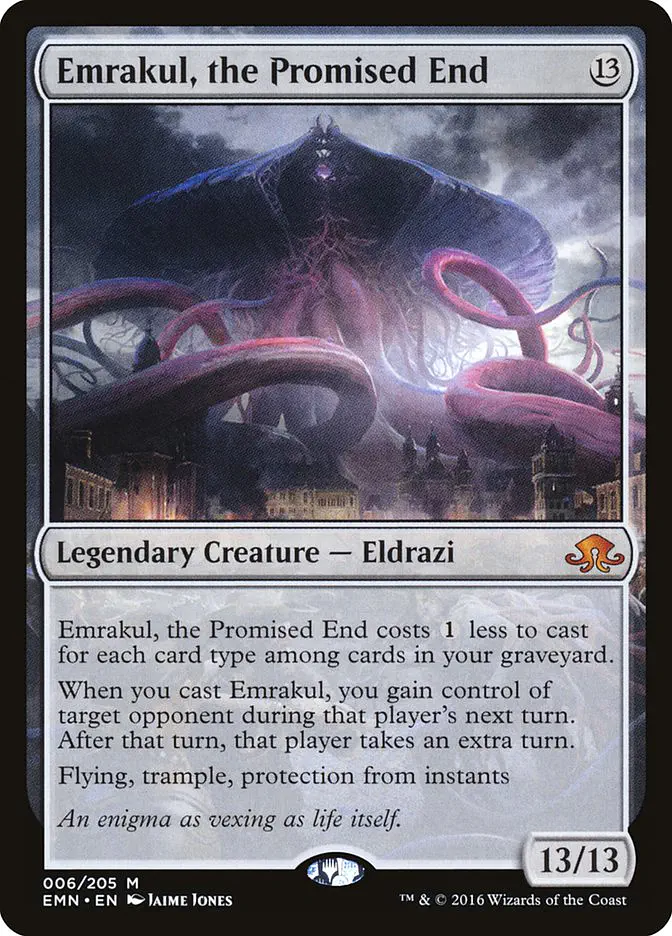
PLAYER 1 is controlling PLAYER 2's turn due to the effect of Emrakul, the Promised End. PLAYER 1 asks what would happen if they cast another Emrakul, the Promised End during the turn they control PLAYER 2. (In this scenario, the second Emrakul, the Promised End is owned by and in the hand of PLAYER 2).
The Resolution: Once PLAYER 2's turn under PLAYER 1's control ends, PLAYER 2 will play the extra turn granted by the trigger of the first Emrakul, the Promised End cast by PLAYER 1.
Once PLAYER 2 finishes this extra turn, PLAYER 1's regular turn will begin, but it will be played under PLAYER 2's control due to the effect of the second Emrakul, the Promised End hypothetically cast by PLAYER 1 during the turn they controlled PLAYER 2.
After this turn, PLAYER 1 will play an extra turn granted by the trigger of the second Emrakul, the Promised End.
Rules Applied: CR 500.7.
Case 2


PLAYER 1 controls Damping Sphere, while PLAYER 2 has a Forest enchanted with Utopia Sprawl. PLAYER 2 asks what would happen if they tap the enchanted Forest for mana.
The Resolution: The Forest itself produces one mana. The triggered ability of Utopia Sprawl adds one additional mana of the color chosen by PLAYER 2 when Utopia Sprawl entered the battlefield. Since it is not the land itself producing multiple mana, Damping Sphere does not interfere in any way.
Rules Applied: CR 605.1b.
Case 3
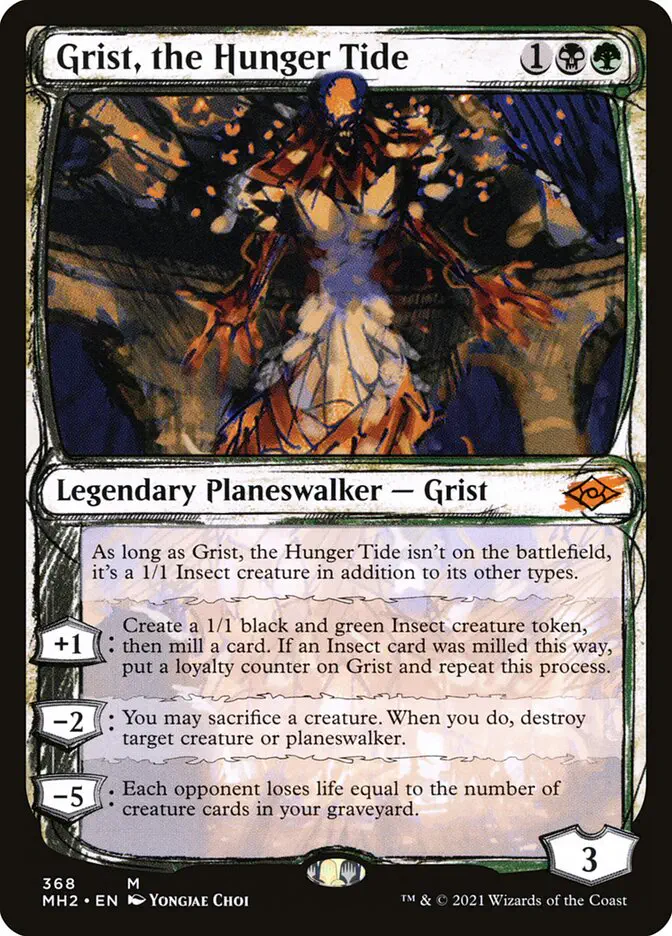
PLAYER 1 controls Grafdigger's Cage. PLAYER 2 wants to cast Green Sun's Zenith to search their library and put Grist, the Hunger Tide onto the battlefield. PLAYER 2 asks if this is legal.
The Resolution: No, this is not legal. Even though Grist, the Hunger Tide is not a creature once on the battlefield, the effect of Grafdigger's Cage refers to "creature cards," meaning it looks at the characteristics of Grist, the Hunger Tide as a card, not as a permanent on the battlefield. Indeed, Grist's first ability makes it a Legendary Planeswalker - Grist Insect creature card in all zones other than the battlefield.
Rules Applied: CR 109.2, CR 109.2a, CR 113.6c, CR 614.17d.
Case 4

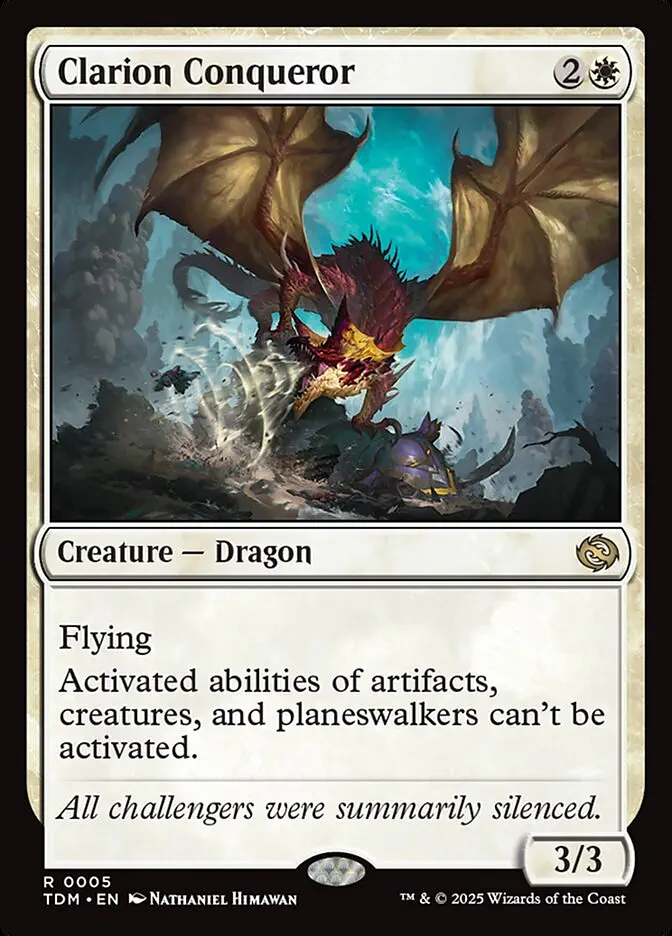
PLAYER 1 has a Cauldron Familiar in their graveyard and controls a Food token. PLAYER 2 controls Clarion Conqueror. PLAYER 1 asks if they can activate Cauldron Familiar's ability to return it to the battlefield from the graveyard.
The Resolution: Yes. Unlike the previous case with Grafdigger's Cage, Clarion Conqueror refers to the activated abilities of "creatures." When an effect specifies a card type without adding the word "card(s)," it means "permanents of that type on the battlefield." Since Cauldron Familiar is not on the battlefield, Clarion Conqueror does not stop its activated ability from being activated.
Rules Applied: CR 109.2.
Case 5


PLAYER 1 controls Trinisphere and casts a spell with mana value four. PLAYER 2 controls an Island (their only untapped land), two untapped artifacts, and has Metallic Rebuke in hand. Can they use Metallic Rebuke to counter PLAYER 1's spell?
The Resolution: Yes. Improvise is a keyword ability that does not reduce the casting cost of the spell, but rather allows PLAYER 2 to use an alternative method to pay for the mana. Therefore, the cost of Metallic Rebuke is 3, and PLAYER 2 can tap artifacts as part of paying that cost without Trinisphere altering this process.
Rules Applied: CR 601.2f, CR 701.126b.
Case 6


PLAYER 1 is controlling PLAYER 2's turn due to the effect of Emrakul, the Promised End. PLAYER 1 asks if they can look at the card exiled face down with Hideaway via Fight Rigging.
The Resolution: Yes. While a player controls another player, they have access to all in-game public and private information that the controlled player would have access to. This includes any face-down cards PLAYER 2 is allowed to look at.
However, PLAYER 1 does not gain access to PLAYER 2's cards outside the game, even if an effect instructs them to do so (for example, if they cast Wish while controlling their opponent, they cannot access the sideboard to play a card, nor are they allowed to look at it).
Rules Applied: CR 723.4.
The Live Stream
As for the streaming side of things (which you can catch up on here: https://www.twitch.tv/videos/2871996426), we had three top-tier competitive players on commentary: Marco "TrueHero" Vassallo and Guglielmo Lupi, both MOCS Champions, alongside the always delightful and witty Filippo Maria Chiappini.
The stream kept its "King of the Hill" format: Decio Sacco, the champion of the last edition, defended the throne with Broodscale until going 3-0, when he was defeated by Izzet Prowess expert Pietro Maria Oltolina, who remained undefeated on the feature match stream until the end of the event. We later found Decio just one step away from the Top 8, stopped in his win-and-in by Pietro Daminelli on Amulet Titan.
Other stream highlights included Giulio Tommaso Gomitoni pulling off a spectacular win against Jeskai Control with a clutch Warping Wail targeting Wrath of the Skies, and Giulia Grillini, who managed to take a game off Goryo's Vengeance with Boros Energy despite a mulligan to five.
That wraps up this TO retrospective. Remember to check your EUL standings to make sure your points have been correctly credited.
For those who aren't familiar with the circuit yet, it's definitely worth checking out. Head to your local WPN Stores and ask them to run European Unity League events, which scale from simple local tournaments all the way to the season-ending European Championship. You can find all the useful information here: https://unityleague.gg/info/.
It was an amazing run.
See you Space Cowboy
Francesco

Want to publish articles?
Share stories about your journey in Magic, your favorite decks, and more!
Request publishing access